
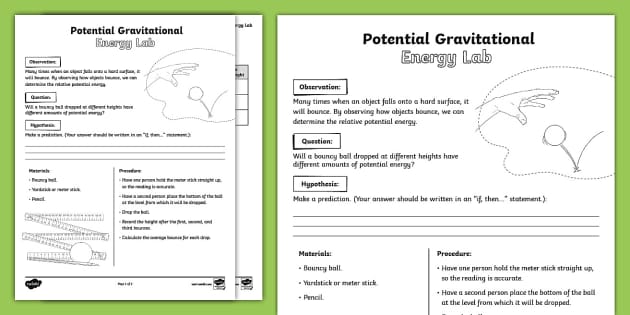
In the realm of physics, understanding the fundamental concepts of energy is crucial for grasping the workings of the universe. Among these concepts, kinetic and potential energy stand as pillars, governing the motion and state of objects. To delve deeper into these concepts and aid in comprehension, educators often rely on worksheets. In this article, we will embark on an insightful journey through a kinetic and potential energy worksheet, unraveling the intricacies and applications of these essential concepts.
Kinetic and potential energy are two forms of energy that objects possess by virtue of their motion or position, respectively. The interplay between these energies shapes the dynamics of countless natural phenomena, from the flight of a bird to the orbit of celestial bodies. The worksheet provided here serves as a tool to engage learners in hands-on exploration, enabling them to internalize the principles governing kinetic and potential energy.
Section 1: Understanding Kinetic Energy
The first section of the worksheet delves into kinetic energy, the energy of motion. It begins with a brief overview of the concept, elucidating how kinetic energy relates to an object’s mass and velocity. The exercises progress from simple calculations to real-world applications, encouraging students to apply the formula for kinetic energy (KE = 1/2 mv^2) to various scenarios.
Questions may prompt students to calculate the kinetic energy of a moving car, a sprinting athlete, or a roller coaster at the peak of its descent. Such exercises not only reinforce mathematical skills but also foster an intuitive understanding of kinetic energy’s significance in everyday situations.
Section 2: Exploring Potential Energy
Transitioning to potential energy, the worksheet navigates through the energy stored within objects due to their position or configuration. Whether it’s gravitational potential energy, elastic potential energy, or chemical potential energy, learners are presented with diverse examples to broaden their understanding.
Students may encounter problems involving the calculation of gravitational potential energy based on an object’s height and mass, or the determination of elastic potential energy stored in a stretched spring. Through these exercises, learners uncover the role of potential energy in phenomena ranging from pendulum swings to the operation of a bow and arrow.
Section 3: Kinetic and Potential Energy in Action
The final section of the worksheet integrates kinetic and potential energy, illustrating their dynamic interplay in real-world scenarios. This section often features problem-solving tasks that require students to analyze the transformation of energy within a system.
Tasks may involve calculating the total mechanical energy of a swinging pendulum, considering how kinetic and potential energy interchange throughout its motion. Alternatively, students might explore the concept of conservation of energy by examining a roller coaster’s journey, tracing the conversion between kinetic and potential energy at various points along the track.
Conclusion: Empowering Learning Through Worksheets
In conclusion, worksheets centered on kinetic and potential energy serve as invaluable educational tools, offering a structured approach to conceptual understanding and skill development. By engaging in problem-solving activities and real-world applications, students not only master the principles of energy but also cultivate critical thinking and analytical abilities.
As educators, incorporating such worksheets into teaching curricula enhances the learning experience, fostering curiosity and enthusiasm for physics. Through hands-on exploration and guided inquiry, learners embark on a journey of discovery, unraveling the mysteries of kinetic and potential energy one worksheet at a time. So, let’s embrace the power of educational resources like the kinetic and potential energy worksheet, igniting the spark of learning and inquiry in minds young and old alike.
